Hello Everyone and Happy October!
I’m writing this as the leaves are starting to change (right on time for the Boston area) and the desperately needed rain is pouring down. September was plagued by drought conditions, and October is trying to rectify that.
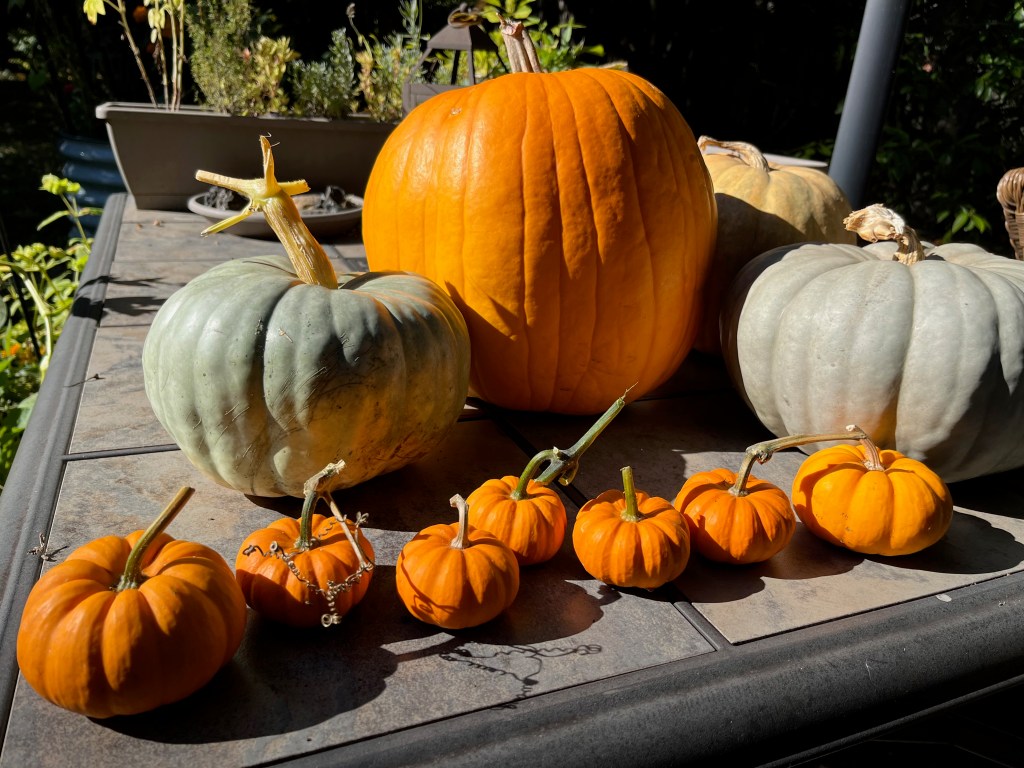
With the soil being so dry, the delicious smell of the rain soaking into the dirt is hitting my brain. Petrichor. Earthy, alive. Humans are hardwired to love it. Check out The Seedling section for more information.
Two Tools and Three Sowings are little nuggets of knowledge because knowledge is power! You’ll find helpful gardening tools and resources in Two Tools. Three Sowings are tasks you can focus on for the present month.
My in-depth post this week is about a native plant that’s new to my garden: White Snakeroot. I’m trying to encourage more natives to make a home in my large garden plot, and this appeared out of nowhere. We can learn about it together today!
The Seedling
Petrichor (PEH•tree•kor)
: a distinctive, earthy, usually pleasant odor that is associated with rainfall especially when following a warm, dry period and that arises from a combination of volatile plant oils and geosmin released from the soil into the air and by ozone carried by downdrafts. (Merriam-Webster)
It’s a chemical reaction when rain hits the dry (and usually warmed) soil, releasing a molecule (geosmin) created by bacteria living in the dirt. That bacteria is good – its existence proves that your soil is healthy. And it smells so alive, so fresh. I find it clears my head and focus on the present moment.
Two Tools
This week’s resources are two plant identification apps that I’ve found incredibly useful.
PlantNet (available in the Google Play and Apple App Store)
PictureThis (available in the Google Play and Apple App Store)
I’ve found using one is about 75-80% accurate. But using both gives me 95% accuracy on helping me identify mystery plants, like the White Snakeroot I found.
GrowIt BuildIt did a very thorough review of the top seven plant ID apps out there by running 234 images through each of them, and agreed these two are the best. Check out the whole video on YouTube.
Three Sowings
#1 – Leave the leaves! Keeping leaves on the ground gives the beneficial insects and pollinators a place to hide for the winter. Come spring, you will have a healthier mini-ecosystem in your garden, which will help your community as well.
#2 – Clean up any vines before they become brown and withered. They will snap off into small pieces that are much more difficult to remove from your trellises and fences. Green vines will pull off in one clean sweep with just some gentle tugging.
#3 – Either collect and dry spent blooms to save the seeds, or leave them on the place for the birds to feast on. Regardless, leave some hollow stems behind for insects to overwinter in or leave their eggs in for next spring.
Get to Know Your Plant
Welcome to my on-going series, Get to Know Your Plant, where we take an in-depth look at a specific plant you may have growing in your garden or in your neighborhood. We’ll talk about its origins, needs for light / soil / water / space, and the why/why not about growing it.
White Snakeroot
You may have seen this in your garden at some point, especially if you’re encouraging more native plants:

You may think this is a weed. We tend to think of weeds as not pretty, gangly, something you didn’t plant or invite in. But the native White Snakeroot (Ageratina altissima) is not a weed, although when it first pops up you may think it’s acting like one.
Origins
White Snakeroot is native to the US and Canada. It is commonly found along woods and thickets, woodland edges, near sheltered waterways, and in recently disturbed, shaded sites.
Native Distribution: S. Ontario to New Brunswick; south through New England to Virginia and upland Georgia; west to Louisiana and ne. Texas; north to Wisconsin.
USA states: AL, AR, CT, DC, DE, FL, GA, IA, IL, IN, KS, KY, LA, MA, MD, ME, MI, MN, MO, MS, NC, ND, NE, NH, NJ, NY, OH, OK, PA, RI, SC, SD, TN, TX, VA, VT, WI, WV
Canadian Provinces: NB, NS, ON, SK
Growing Information
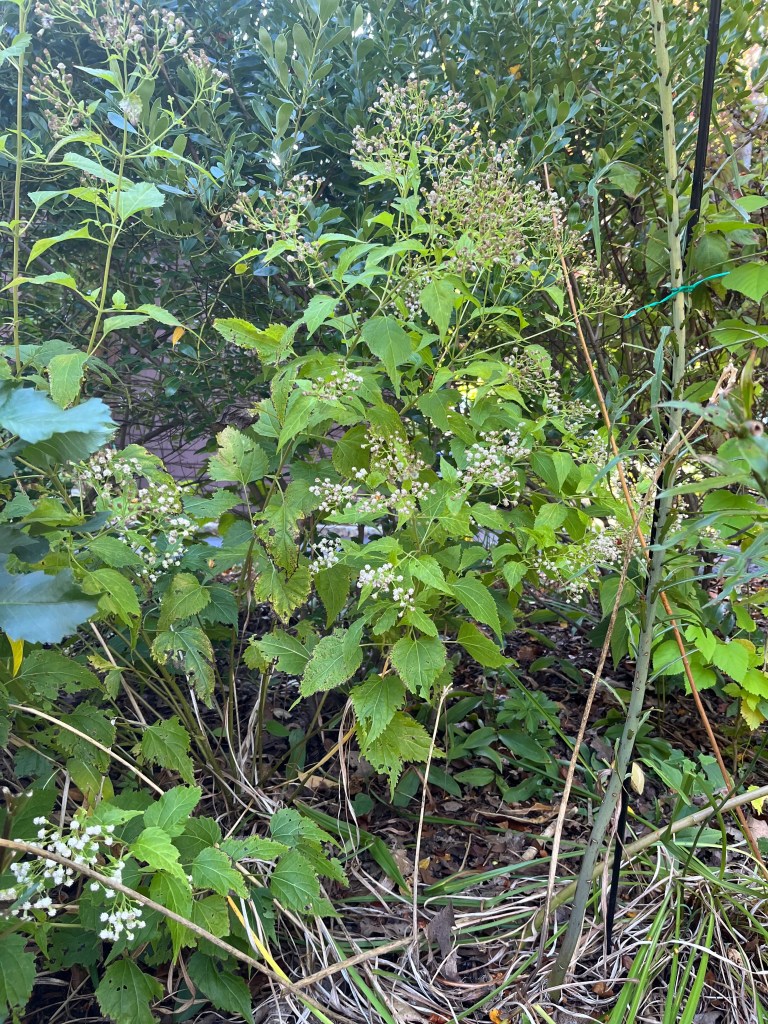
White Snakeroot is most noticeable when it forms its clusters of small, foamy white flowers. Its height – two to four feet – also makes it stand out from the other plants in your garden. The leaves look like elongated hearts, with jagged edges that look like teeth.
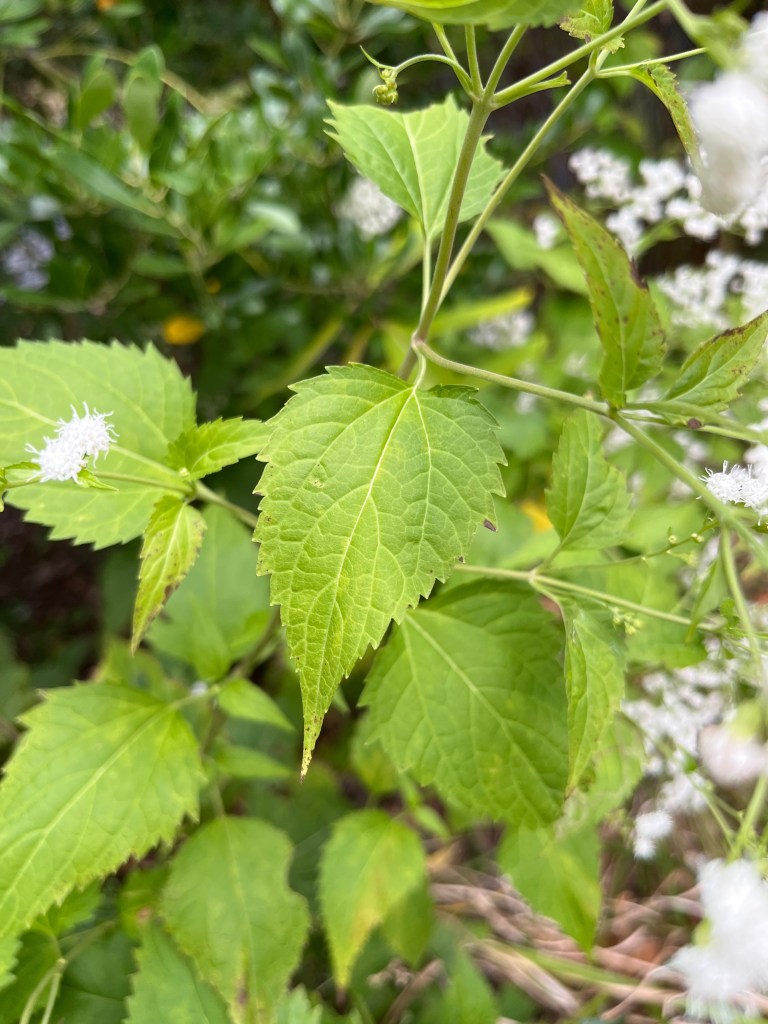
It starts blooming in late summer, but will keep going through the fall and into the first frost. If the flowers are fertilized, they turn into fluffy tufts like miniature dandelion seedheads. And just like dandelions, they will float away in the breeze.
Ageratina altissima grows best in moist soils, in shade or partial sun. It is usually found along woodland edges, near sheltered creeks and streams, and in recently disturbed shaded sites.
If you do dig up soil that has snakeroot seeds, its initial flush of plants may seem overwhelming and weedy. White Snakeroot spreads by rhizomatous roots (subterranean plant stem that sends out roots and shoots from its nodes) to make a lot of plants all at once. It is also a quick self-seeder. However, this plant does settle down once an area is established and will grow peacefully among other plants. Imagine those darling flowerheads among some purple salvia or bright bee balm!
Why Grow It
Supports Conservation Biological Control (A plant that attracts predatory or parasitoid insects that prey upon pest insects)
The tiny white flowers can host and feed a variety of insects including bees, pollinator flies, and moths, especially in the fall when other flowers have died back. A number of caterpillars are known to feed on the foliage, including the Ruby Tiger Moth caterpillar.

Why to Not Grow It
So here is where this plant has some interesting history.
This plant is typically avoided by mammalian herbivores because its foliage is very bitter. Usually in the plant world, a very bitter taste means poisonous or toxic. This particular plant contains the toxin tremetol, which causes “the trembles” in cattle and other livestock who eat it.
When European colonists arrived, they learned the hard way that if cattle ended up eating white snakeroot, their milk would turn poisonous. People who drank this milk found themselves with a bad case of “milk sickness,” an illness that causes flu-like symptoms and even death. Allegedly Abraham Lincoln’s mother passed away due to milk sickness.
Is this Plant for Me?
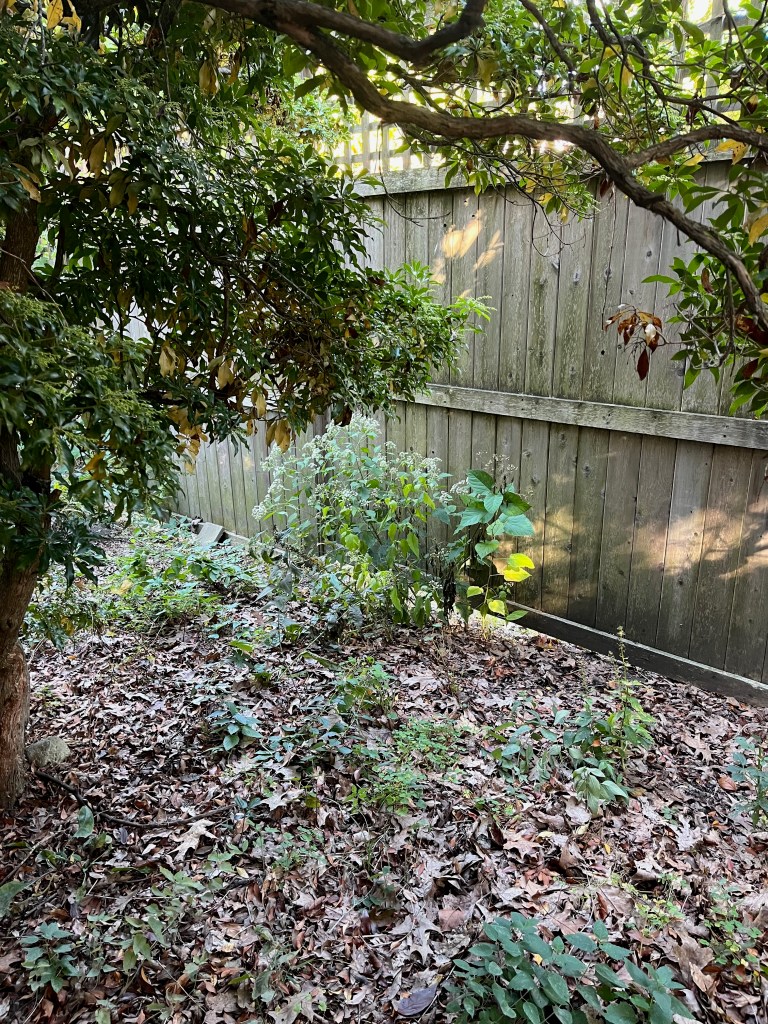
If you’ve been encouraging a native / pollinator friendly garden, this may pop up all on its own. Especially if you’ve recently been digging up the soil, which can disturb the weed seed bank already there.
It will appear to be aggressive when it first comes up, but it will play nice with your other plants and won’t be so numerous the following year. It will also draw in insects that prey upon pests.
It can be extremely toxic if consumed, so if you have young children or dogs, make sure you locate the plant in an area where they cannot reach it.
I will be keeping it in my yard, as a way to support native pollinators and moths, knowing it won’t take over the whole garden space. I hope you consider this lovely little white-flowered native!
[information from the Lady Bird Johnson Wildflower Center (accessed 2024 Oct 7), The Xerces Society (accessed 2024 Oct 7), and Prairie Moon Nursery (accessed 2024 Oct 7)]
 Gardening For the End of the World
Leave a comment